
The Art of Vibrato
A structured approach to vibrato technique and expression.
Designed for serious adult violinists and teachers.

Designed for serious adult violinists and teachers.
Vibrato is one of the most misunderstood technical subjects in violin training. Many violinists receive little instruction in how vibrato is built, how it functions mechanically, or how different vibrato types are applied musically.
When vibrato is taught casually, the result is often tension, narrow oscillation, hand collapse, disrupted bowing, or an expressive habit that cannot be shaped with intention.
The Vibrato Discipline of the Broadbent School was created to address these issues directly — calmly, structurally, and without the pressure to “get it quickly.”
The Art of Vibrato is the vibrato discipline of the Broadbent School of Violin Artistry. It is a comprehensive study of how vibrato is built, controlled, and applied musically on the violin.
This work includes first vibrato development, second vibrato acquisition (hand ↔ arm), hand independence, and expressive use in repertoire.
This discipline is not tied to age, level, or repertoire. Teachers, advanced amateurs, and returning violinists revisit it as part of long-term musical development.
Vibrato is not a cosmetic effect or “finishing touch.” It is a tonal and expressive mechanism that requires clarity of setup, motion, sequencing, and application.
Many violinists — including highly trained ones — were never taught vibrato as a coherent system. They were shown pieces, given vague corrections, and told to “relax” or “use more vibrato” without the underlying mechanics ever being addressed.
This discipline exists to make vibrato clear, dependable, and musically usable — without tension, guesswork, or performance panic.
Most adult violinists who self-teach vibrato eventually encounter one or more of the following:
• unclear left-hand setup
• thumb/finger interference
• tension-based oscillation
• difficulty sustaining vibrato through bow changes
• inability to adjust width or speed
• vibrato that disrupts tone rather than enriches it
• uncertainty between hand vs. arm motion
• difficulty integrating vibrato into repertoire
These issues are not personal deficiencies — they are the result of an incomplete pedagogical sequence.
This discipline teaches violinists to:
• develop healthy vibrato motion without tension
• choose and refine hand or arm vibrato
• sustain vibrato through bow changes
• coordinate vibrato with tone, phrasing, and dynamics
• adjust speed and width for expressive purposes
• integrate vibrato into repertoire without collapse
• understand vibrato as a tonal tool — not decoration
The result is vibrato that feels intentional, reliable, and musically integrated.
The Vibrato Discipline treats vibrato as both a technical and musical subject. Study includes:
— foundational setup
— motion mechanics
— muscle preparation
— practice sequencing
— hand independence
— application to phrase and colour
— workshop-level integration
— Q&A study material
All lessons are self-paced. No deadlines, no cohort pressure, and no “challenge” performance expectations.
This discipline is organized into six areas of study:
Instrument hold, thumb/finger balance, ergonomic alignment, and conditions for healthy vibrato motion.
Motion pathways, oscillation, directional control, and choosing a first vibrato type.
Isolated conditioning exercises for developing motion without tension or collapse.
Developing vibrato that does not disrupt tone, bowing, or intonation.
Using vibrato to support tone, continuity, dynamic shaping, and expressive intention.
Recorded workshops, demonstrations, and discussion for deeper technical and musical context.
• Introduction to Vibrato Workshop
• Setting a Healthy Foundation Tutorial Series
• Preparatory Vibrato Exercises (Hand & Arm)
• Vibrato Practice & Application Lessons
• Free Your Inner Vibrato 5-Day Series (short tutorials)
• Vibrato Quickie Workshop + Q&As
• 5-Part Vibrato Workshop Series (with PDFs)
All study materials are self-paced. No deadlines, no cohort pressure, and no performance expectations.
This work serves:
✓ adult beginners without vibrato
✓ returning violinists seeking clarity
✓ players with tension-based vibrato
✓ teachers seeking structured pedagogy
✓ violinists adding a second vibrato (arm ↔ hand)
It is not level-bound and can be revisited throughout a player’s lifetime.
The Broadbent School is organized as rooms, not levels. Each room represents a permanent area of study — one that is entered, revisited, and integrated over time.
The Vibrato Discipline lives inside the Tone Room. It supports the expressive component of sound production and builds upon the technical work of bow control, contact point, and acoustic clarity.
Students return to this discipline when:
• vibrato feels tense, narrow, or collapsed
• tone becomes unstable through phrasework
• expressive demands increase
• teaching responsibilities require clarity
• repertoire exposes vibrato gaps
This discipline does not replace tone, repertoire, or technique.
It supports all of them.
For all my struggles with vibrato which has been many years, I think I am seeing the light at the end of some sort of tunnel.
This program is priceless. I have just begun to have a vibrato earlier this year but your instruction helped me realize it was a tension vibrato. I am now on the path to creating a relaxed vibrato.
I could not even attempt vibrato a year ago. Now I can. The clarity and structure of this program have been invaluable.
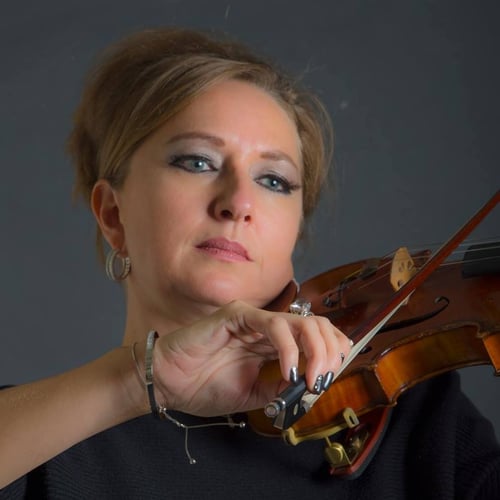
Heather Kaye Broadbent is an international violinist, pedagogue, and composer with a specialization in adult violin education. She is the founder of the Broadbent School of Violin Artistry, where her work centers on thoughtful technique, expressive development, and humane, lineage-informed pedagogy.
Over the past decade, Heather has taught and supported violinists from around the world through online study, workshops, private instruction, and published materials. Her teaching is known for its clarity, calm structure, and respect for the serious adult learner. She places strong emphasis on ergonomic setup, healthy mechanics, and the integration of technical skill with musical intention.
At the Broadbent School, she continues her mission of offering adult violinists and teachers access to structured study—free from the haste, pressure, and confusion that often accompany traditional training. Her vibrato pedagogy in particular reflects years of refinement and a commitment to addressing a technical subject that is frequently misunderstood and rarely taught with full context.


