

Seven Positions. Eight Weeks. One Connected Fingerboard.
You know first and third positions. Now it's time to understand the rest of the fingerboard.
Imagine opening a piece of music and recognizing where the notes belong—whether you're playing in second, fourth, fifth, sixth, or seventh position.
Imagine understanding the relationships between positions rather than memorizing each one as a separate territory.
And imagine approaching shifts with a clear sense of where you're going, rather than hoping your fingers arrive in the right place.
The fingerboard is not seven disconnected positions. It is one connected system.
Once you begin to understand that system, everything from reading unfamiliar notes to choosing fingerings and developing accurate shifts becomes more approachable.
I developed Fingerboard Fluency to help violinists build this understanding through a carefully structured, accelerated course of study.
Originally taught as an eight-week live intensive, the program brings together years of traditional position training into one systematic learning pathway.
And because understanding positions is only part of becoming fluent, I've included my complete eight-week Seamless Shifting study.
Two complementary studies. Sixteen weeks of structured training. One comprehensive approach to the fingerboard.
Follow the original accelerated schedule or work through the materials at your own pace.

Third Position Is the Launching Pad, Not the Destination
In much of today's traditional violin instruction, students spend years working primarily in first and third positions. Other positions are often introduced only when repertoire demands them, while conventional position-study books can take years to complete.
Yet the great violin pedagogues of the 19th century—including Delphin Alard, Charles Dancla, Hans Sitt, and Otakar Ševčík—incorporated systematic positional training into their teaching methods, sometimes introducing it surprisingly early in a violinist's development.
Why not return to that tradition?
Rather than spending years studying positions in isolation, we can learn to recognize familiar finger patterns, read notes, and develop intonation directly in each new position.
Third position becomes the launching pad for exploring the entire fingerboard—not the destination.
Fingerboard Fluency brings this systematic approach into a focused, progressive study of the first seven positions.
The goal is not simply to reach higher positions. It's to understand where you are, what you're playing, and how the entire fingerboard connects.

What If You Could See the Fingerboard as a Grid?
Imagine opening an unfamiliar piece of music and recognizing the positional possibilities before you begin playing.
Imagine understanding how notes relate across strings, how familiar finger patterns reappear in different positions, and how the same pitch can be approached from different locations.
Instead of feeling that you must memorize seven separate positions, you begin to recognize one connected structure.
This is the foundation of positional language and parallel awareness.
Through systematic finger-pattern studies, scales, arpeggios, and carefully organized technical exercises, I teach you to recognize the relationships that connect the first seven positions.
As your understanding develops, you can begin to:
- Read notes with greater confidence throughout the fingerboard.
- Recognize familiar finger patterns in unfamiliar positions.
- Understand positional relationships across all four strings.
- Develop greater independence when selecting fingerings.
- Strengthen intonation through clearer pitch awareness.
- Navigate between positions with greater purpose.
- Apply your technical knowledge to repertoire rather than relying exclusively on memorized passages.
My goal isn't simply to teach you where to put your fingers. It's to teach you associations to learn faster and be consistent in sight reading with reliable intonation before and after shifting.
Why I Created Fingerboard Fluency
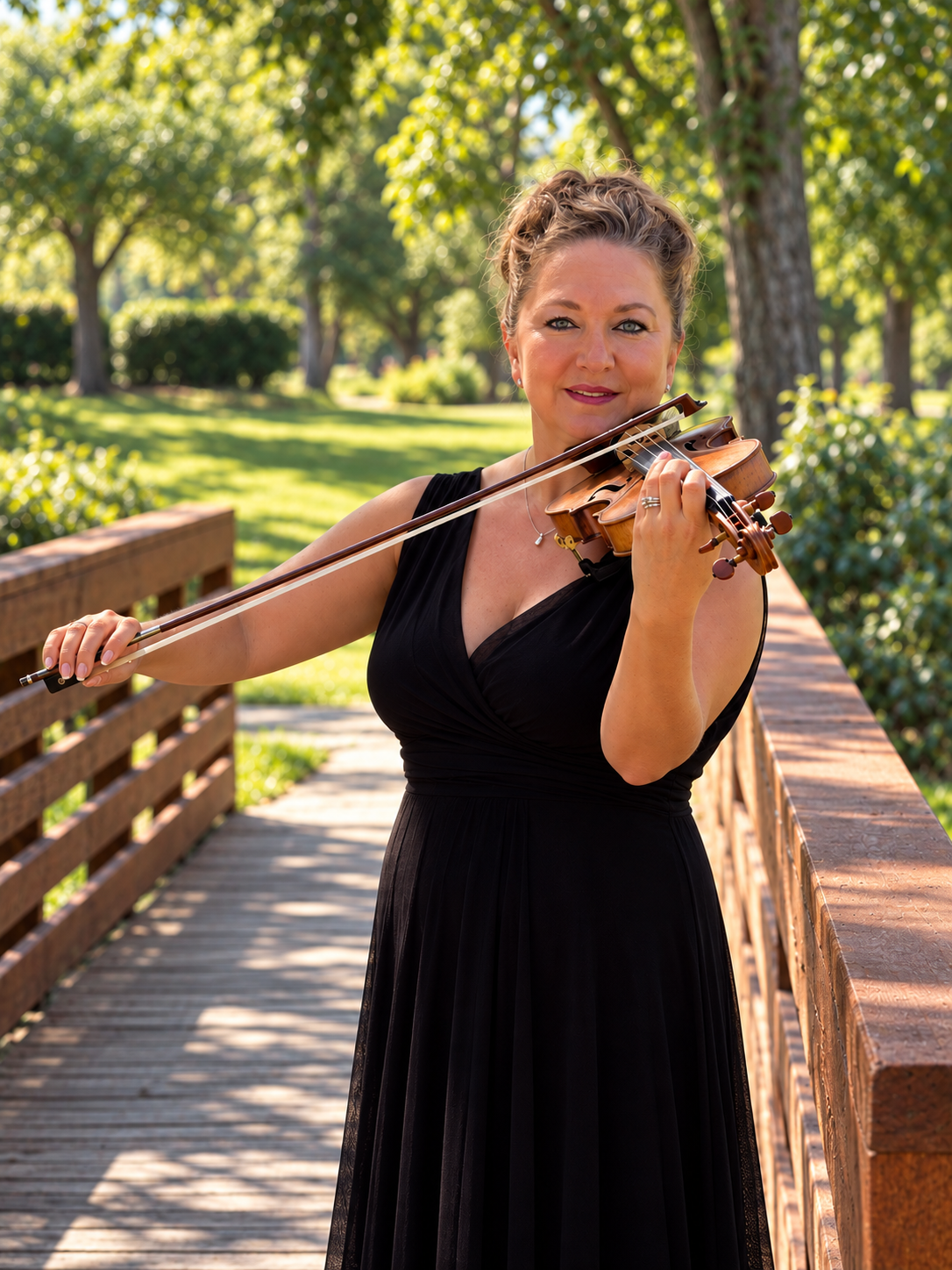
For years, I taught violinists using traditional position books and established methods.
These materials have tremendous pedagogical value, and they remain an important part of violin education.
But I began recognizing a recurring problem.
Students could spend years studying individual positions without developing a connected understanding of the fingerboard.
They might play confidently in third position yet feel completely uncertain in second or fourth.
They could memorize shifts within repertoire without necessarily understanding the positional relationships behind them.
I also understood this experience personally.
During my own development as a professional violinist, I encountered gaps in my positional training that became particularly apparent in orchestral repertoire.
I remember preparing for a concert cycle and realizing that I needed a more deliberate understanding of what I was doing in the upper positions.
I studied the music thoroughly, examining the technical and positional relationships behind the passages.
The more clearly I understood what I was playing, the more confident I became.
That experience reinforced something I continue to believe as a teacher:
Knowledge creates confidence.
I wanted my students to develop that knowledge systematically, rather than spending years working through individual position studies and discovering those relationships through trial and error.
So I brought together the technical principles I had been teaching for years and organized them into a concentrated, progressive method.
Fingerboard Fluency grew out of that work.
Seven Positions in Eight Weeks: The Power of Momentum
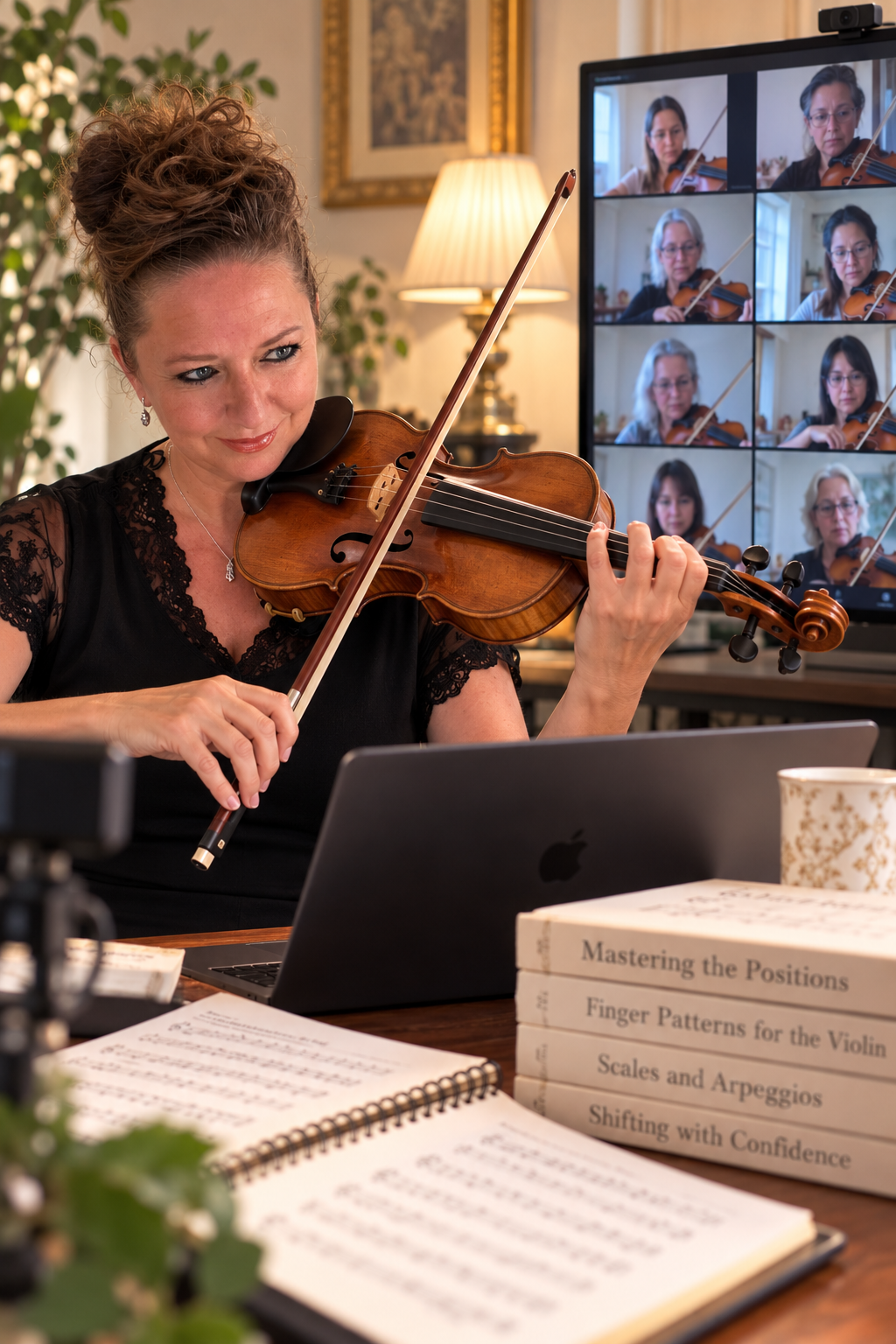
When I originally developed this program, I taught it as a live eight-week intensive.
Students worked through my instructional books, exercises, and video lessons, and we met for group coaching every two weeks.
The prerequisite was an established understanding of third position.
That was important because third position provided the foundation for the momentum I wanted students to experience.
Instead of spending months or years studying individual positions in isolation, we worked systematically through the first seven positions over eight focused weeks.
Each stage built upon the previous one.
Students began recognizing the relationships across the fingerboard while those discoveries were still fresh.
The momentum was intentional.
My purpose wasn't to suggest that every aspect of positional playing could be perfected in eight weeks.
It was to establish the knowledge, orientation, and technical foundation necessary for continued development throughout the fingerboard.
Eight weeks to build the foundation. A lifetime of music in which to apply it.
Today, you can follow the original accelerated schedule or progress at your own pace.
If you have the time and commitment to maintain the original momentum, I encourage you to experience the program as it was designed.
If you need additional time to absorb a concept, develop a technical skill, or integrate the material into your repertoire, you have the flexibility to do so.
The sequence remains the same.
The pace is yours to determine.
A Violinist Who Discovered the Fingerboard at 80
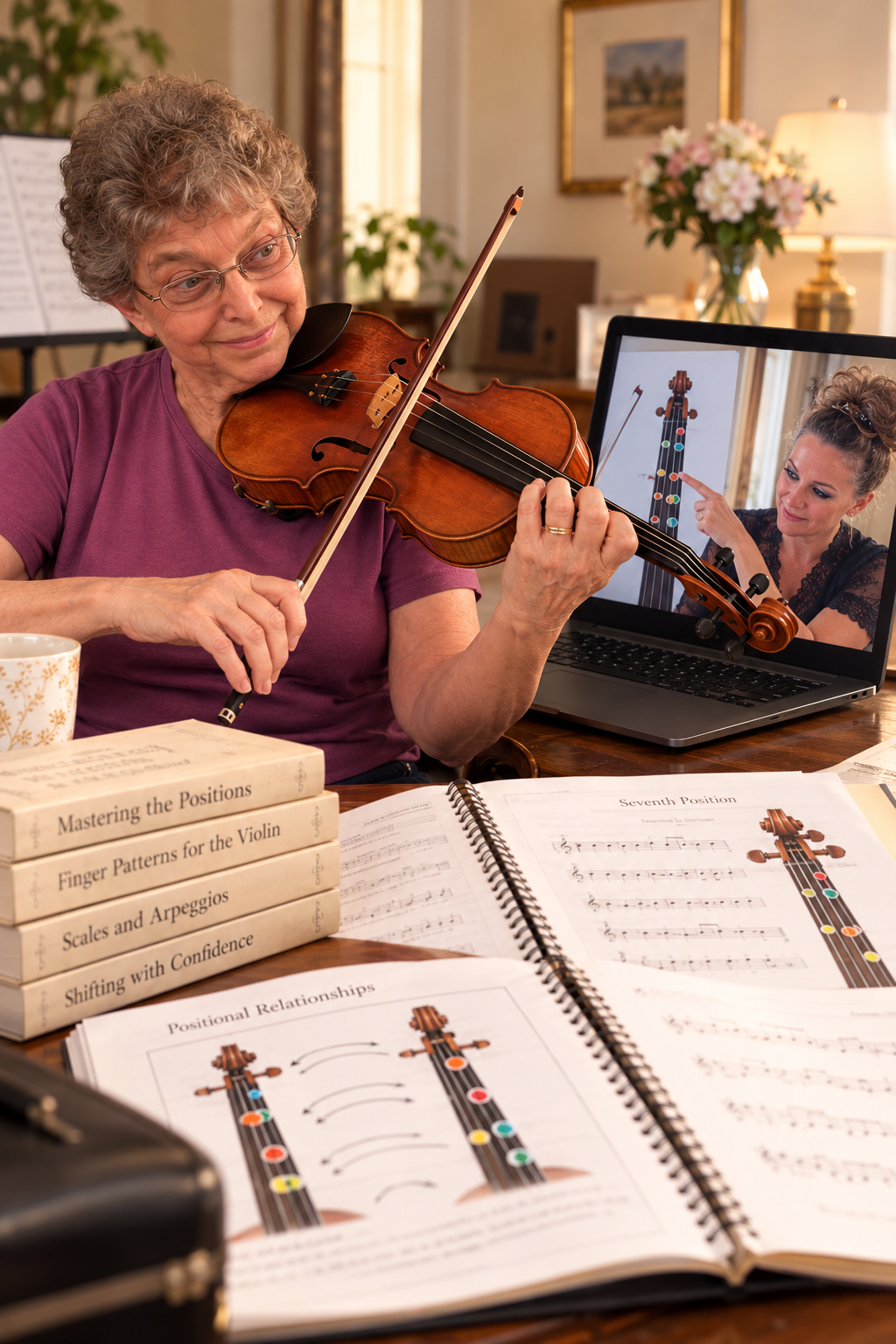
One of my most memorable experiences teaching this method was working with a violinist who was 80 years old.
As she progressed through the program, she began understanding the fingerboard as a grid.
Instead of seeing unfamiliar positions as separate places she needed to memorize, she recognized the relationships connecting notes and finger patterns across the instrument.
She even experienced playing in seventh position for the first time.
What mattered most wasn't simply reaching a higher position.
It was the understanding she developed.
The fingerboard became something she could navigate rather than something she had to fear.
Her experience reinforced one of the most important principles behind my teaching:
Understanding is one of the most powerful tools we can give a musician.
Inside Fingerboard Fluency
Two Complementary Studies. One Complete Approach.
The program combines systematic positional training with focused shifting development.
Together, these studies provide a structured 16-week pathway for developing your understanding and navigation of the violin fingerboard.
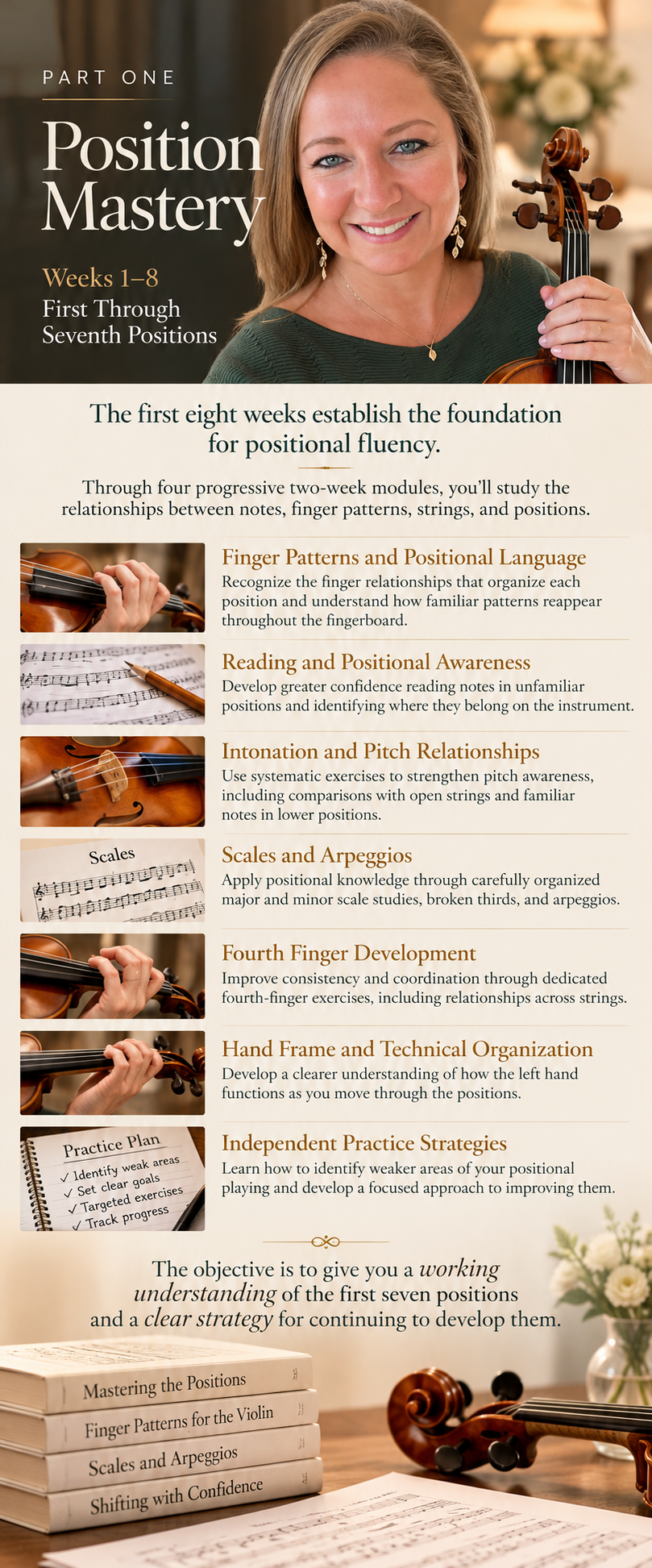
Part One: Position Mastery
Weeks 1–8 | First Through Seventh Positions
The first eight weeks establish the foundation for positional fluency.
Through four progressive two-week modules, you'll study the relationships between notes, finger patterns, strings, and positions.
Finger Patterns and Positional Language
Recognize the finger relationships that organize each position and understand how familiar patterns reappear throughout the fingerboard.
Reading and Positional Awareness
Develop greater confidence reading notes in unfamiliar positions and identifying where they belong on the instrument.
Intonation and Pitch Relationships
Use systematic exercises to strengthen pitch awareness, including comparisons with open strings and familiar notes in lower positions.
Scales and Arpeggios
Apply positional knowledge through carefully organized major and minor scale studies, broken thirds, and arpeggios.
Fourth Finger Development
Improve consistency and coordination through dedicated fourth-finger exercises, including relationships across strings.
Hand Frame and Technical Organization
Develop a clearer understanding of how the left hand functions as you move through the positions.
Independent Practice Strategies
Learn how to identify weaker areas of your positional playing and develop a focused approach to improving them.
The objective is to give you a working understanding of the first seven positions and a clear strategy for continuing to develop them.
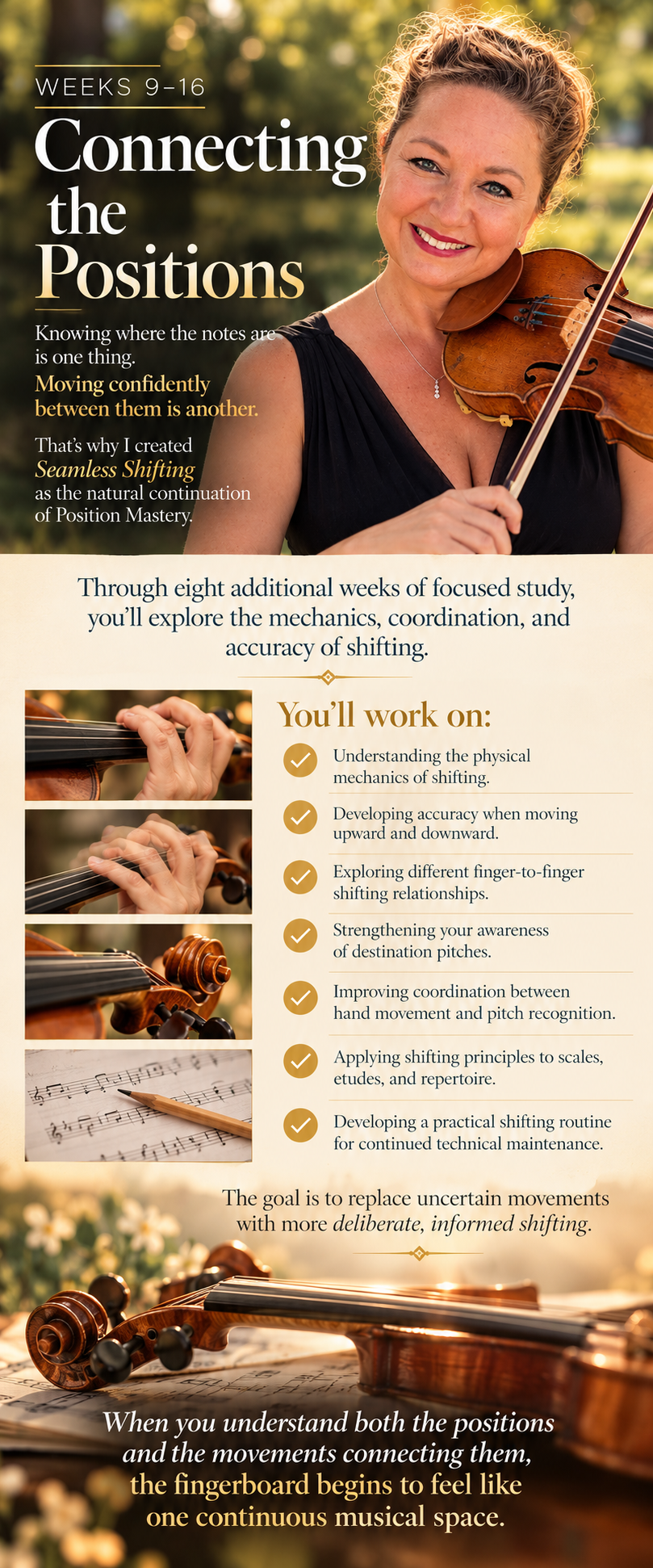
Part Two: Seamless Shifting
Weeks 9–16 | Connecting the Positions
Knowing where the notes are is one thing.
Moving confidently between them is another.
That's why I created Seamless Shifting as the natural continuation of Position Mastery.
Through eight additional weeks of focused study, you'll explore the mechanics, coordination, and accuracy of shifting.
You'll work on:
- Understanding the physical mechanics of shifting.
- Developing accuracy when moving upward and downward.
- Exploring different finger-to-finger shifting relationships.
- Strengthening your awareness of destination pitches.
- Improving coordination between hand movement and pitch recognition.
- Applying shifting principles to scales, etudes, and repertoire.
- Developing a practical shifting routine for continued technical maintenance.
The goal is to replace uncertain movements with more deliberate, informed shifting.
When you understand both the positions and the movements connecting them, the fingerboard begins to feel like one continuous musical space.
Your Instructional Library
Fingerboard Fluency brings together my original instructional publications, video lessons, and technical studies into a coordinated learning pathway.
Rather than searching through unrelated exercises and wondering what to practice next, you have a systematic approach to developing your positional knowledge.
The original curriculum was built around the following studies and resources.

Master the Positions with Finger Patterns
My instructional series introduces positions through the finger-pattern relationships violinists first encounter in first position.
The studies help you recognize those same relationships in new locations while developing note-reading, intonation, and positional awareness.
Playing Through the Positions
A systematic study of the first seven positions across all four strings.
Through varied finger combinations and positional relationships, you'll develop a clearer understanding of the fingerboard as a connected grid.
Fourth Finger Studies
Focused exercises designed to strengthen fourth-finger consistency, coordination, and intonation.
These studies explore finger relationships along individual strings and across string crossings.
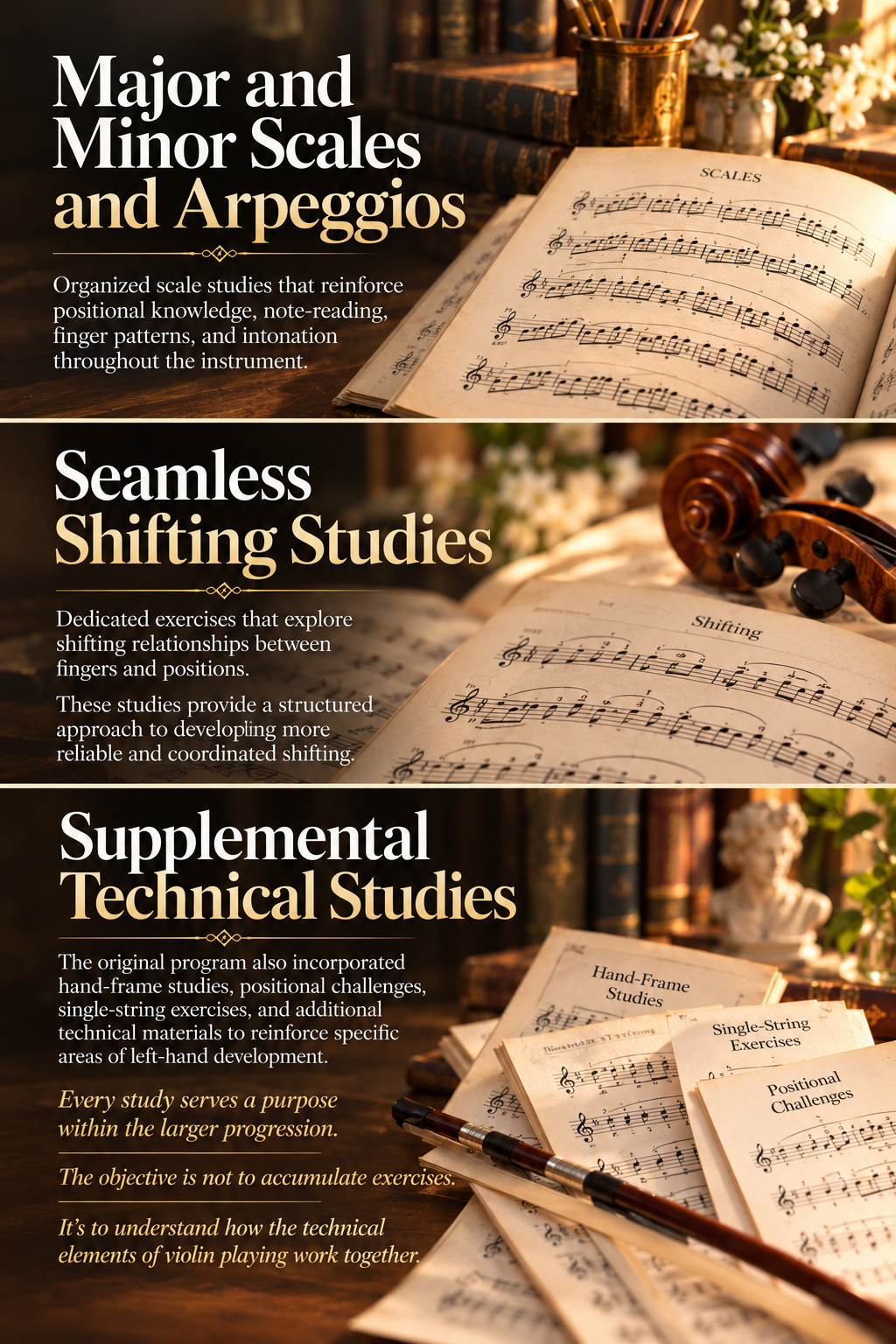
Major and Minor Scales and Arpeggios
Organized scale studies that reinforce positional knowledge, note-reading, finger patterns, and intonation throughout the instrument.
Seamless Shifting Studies
Dedicated exercises that explore shifting relationships between fingers and positions.
These studies provide a structured approach to developing more reliable and coordinated shifting.
Supplemental Technical Studies
The original program also incorporated hand-frame studies, positional challenges, single-string exercises, and additional technical materials to reinforce specific areas of left-hand development.
Every study serves a purpose within the larger progression.
The objective is not to accumulate exercises.
It's to understand how the technical elements of violin playing work together.

A Practice Plan with Purpose
One of the greatest difficulties in independent violin study is knowing what to practice—and in what order.
You may have shelves of excellent books but no clear strategy for bringing the material together.
I designed Fingerboard Fluency to provide that direction.
The original accelerated study recommended the following daily practice commitments:
Recommended Daily Practice
Weeks 1–2: 30–45 minutes
Weeks 3–4 60–75 minutes
Weeks 5–8 90–105 minutes
The subsequent Seamless Shifting study originally recommended approximately 20–30 minutes of focused daily shifting practice, progressing over eight weeks.
These are the practice commitments around which the original intensive was developed. They are not mandatory.
You can spread the material over a longer period, repeat a module, or spend additional time developing a particular technical skill.
What remains constant is the systematic progression.
You'll understand what you're studying, why you're studying it, and how it connects to your larger objectives.
Who Is Fingerboard Fluency For?
I designed this program for violinists who have established a foundation in first and third positions and are ready to develop a more comprehensive understanding of the instrument.
Adult Amateur and Returning Violinists
If you enjoy playing repertoire, participating in chamber music, or performing with a community orchestra, this course can help you approach unfamiliar positional passages with greater understanding.
Advancing Violin Students
If your repertoire is progressing faster than your technical confidence, Fingerboard Fluency provides an opportunity to address gaps in your positional knowledge systematically.
Violin Teachers
If you teach positions and shifting, the method offers a structured way to explore finger patterns, positional relationships, and technical organization that you can apply to your own playing and teaching.
Experienced and Professional Violinists
Even accomplished violinists may discover areas of positional playing that would benefit from focused technical review.
This course provides a comprehensive framework for examining and strengthening those foundations.
Choose a pricing plan
Monthly Access
$29
per month
- A flexible way to begin your study.
- Receive access to the same complete curriculum through a monthly subscription.
- Study the lessons and materials at your own pace.
- Follow the original accelerated pathway or adapt it to your schedule.
- Continue accessing the course while your subscription remains active.
Access & Pricing
$297
One payment. Your complete course of study.
Make a single investment in your positional and shifting education.
Make a single investment in your positional and shifting education.
- Access to the complete Fingerboard Fluency curriculum.
- The eight-week Position Mastery study.
- The additional eight-week Seamless Shifting study.
- Instructional videos and course materials.
- The freedom to revisit lessons whenever you need to review.
- No recurring subscription payments.
What My Students Have Experienced
This Academy took the mystery out of the positions.
This Academy took the mystery out of the positions. As a relative newcomer to playing, and one with aspirations to play with friends and small groups around town, this course helped me understand how to use positions to make travel within melodies easier and better sounding. It opened my eyes to the structure of the violin so that I feel less intimidated when I need to move up, down and side to side. It clarified the mechanics and will be very useful as I attempt to play with different groups and their selections. It has given me more confidence to play with others.
Judith K. — Violinist, Florida, USA
I have gained confidence and an increased understanding of the positions.
Position Mastery and Seamless Shifting Academy is an amazing adventure! Thanks Heather for your special insight on how to teach and implement this training!! Heather has an interesting and enjoyable way of practicing and learning the positions on the violin!
The most wonderful thing about these past 6 months of learning from this Academy is the improvement of my intonation and tone!
Being able to hear the pitches and hit the center of the pitch has improved my playing 100%! I have more confidence and feel I am progressing quickly!
Jann Cook — Violinist, Wyoming
Why Study with Me?
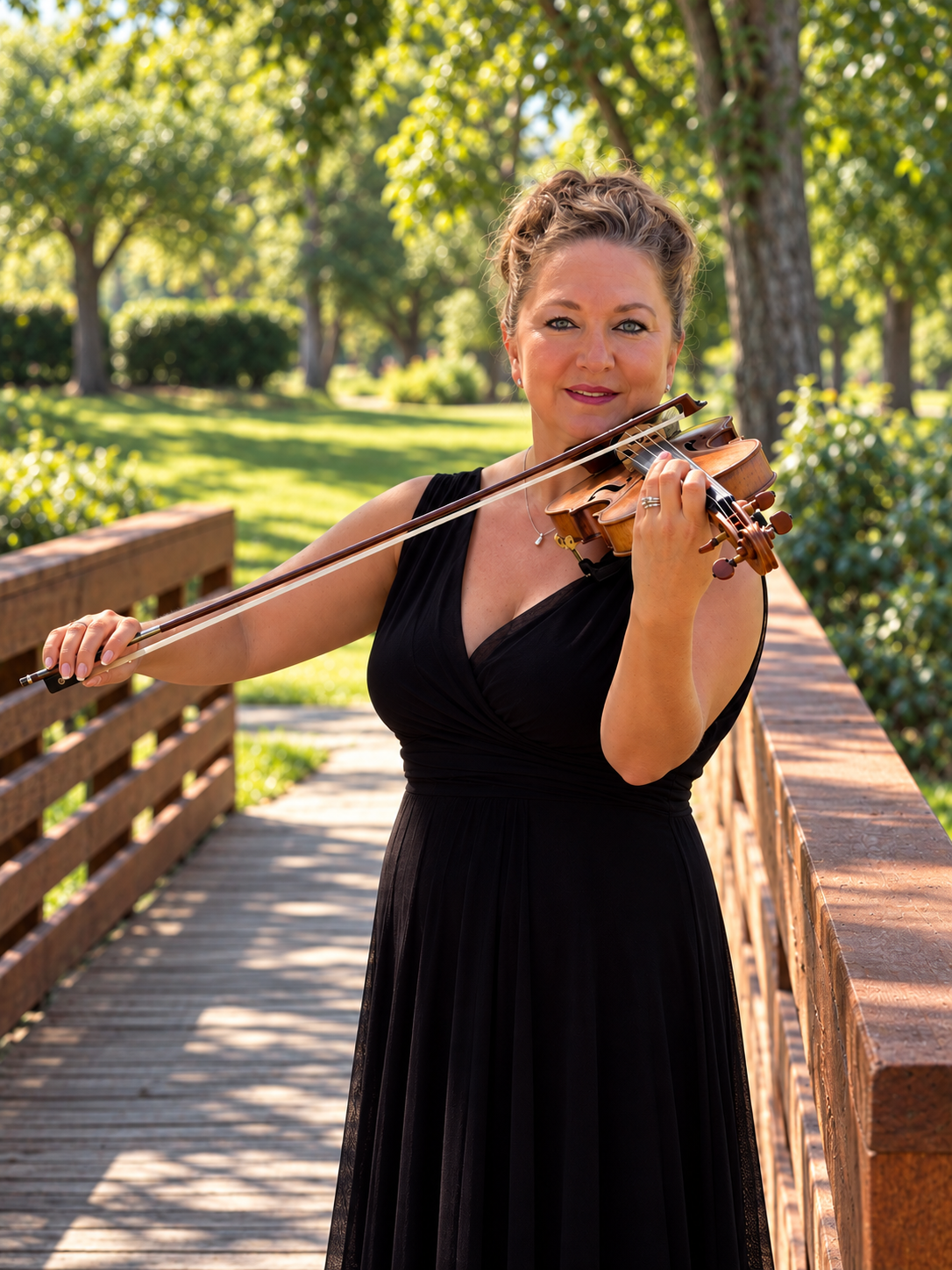
I'm Heather Kaye Broadbent, violinist, performer, and pedagogue, and founder of the Broadbent School of Violin Artistry.
Throughout my career as a performer and teacher, I've been interested not only in what violinists need to learn, but in how they learn it.
My teaching draws upon the principles of traditional violin pedagogy while emphasizing systematic understanding, technical organization, and musical independence.
I believe technique should serve expression.
Understanding finger patterns, positions, shifting, and intonation is not an end in itself.
These skills provide the foundation that allows you to make musical decisions with greater confidence and freedom.
Over years of working with violinists, I've developed original studies and teaching methods to address the technical difficulties that repeatedly prevent students from progressing.
Fingerboard Fluency brings together an important part of that work.