
The Intonation Method
Developing Pitch Awareness, Accuracy, & Consistency
For violinists who were corrected, but never taught — and prefer awareness over shame.

For violinists who were corrected, but never taught — and prefer awareness over shame.
Most violinists were told to “play in tune,” “fix that,” or “listen harder,” but were rarely taught how intonation works or how to develop it.
The result is familiar:
These are not personal deficiencies.
They are the predictable outcome of being corrected without instruction.
The Intonation Method replaces correction with clarity, and shame with awareness.
The Intonation Method is a foundational study in pitch accuracy for violinists.
It teaches how to hear, organize, and produce pitch intentionally — not by bracing, guessing, or hoping for the best.
This work builds:
• pitch awareness and prediction
• left-hand organization and hand frame
• interval recognition and descending stability
• tactile and emotional pitch mapping
• sympathetic vibration and resonance awareness
• relational intonation (sharps, flats, leading tones)
• visual–aural–physical integration
• independence from tuners
• real-time listening strategies
Nothing here requires talent.
It requires teachability.
Traditional pedagogy places intonation inside repertoire — the least forgiving environment for learning it.
Corrections are given:
• during pieces
• in rehearsal
• in lessons
• under pressure
• when the nervous system is already overloaded
This is where many adult violinists first encountered intonation — as public correction, embarrassment, or quiet panic.
The Intonation Method moves intonation to the beginning, where it belongs:
• before repertoire, not inside it
• in a calm, structured environment
• with time to notice, feel, and understand
Intonation becomes teachable when it becomes its own subject.
This method directly supports violinists who experience:
• “I can hear something is off, but I don’t know what to adjust.”
• “I rely too much on the tuner.”
• “My left hand makes my intonation worse.”
• “I don’t know which version of ‘in tune’ applies.”
• “Scales and arpeggios feel uncertain.”
• “Double stops collapse under pressure.”
• “I was shamed into thinking I was bad at pitch.”
Or not knowing when out-of-tune notes occur while playing, only when hearing back the recording.
This is extremely common. If auditory discrimination wasn’t developed in childhood, it simply carries through to adulthood — and can be taught later.
Skill Level:
If you can bow an open string, you can begin this work.
Intonation is built through listening, resonance, and awareness — not difficulty of repertoire.
The Method teaches intonation through five integrated study pillars:
You will build “pitch identity” through:
• resonance on the instrument
• where you feel the pitch in your body
• imagery, color, and emotional associations
• noticing in-tune vs slightly high/low sensations
Instead of memorizing numbers, you learn to recognize pitches as familiar presences.
You will learn how pitch behaves in context, including:
• sharps tuning toward the note above
• flats tuning toward the note below
• leading tones that rise toward resolution
• thirds that lean for sweetness
• harmonic vs melodic tuning environments
“In tune” becomes relational, not absolute.
You will combine three tuning tools:
• Visual — where the note lives on the instrument
• Aural — hearing the note before you play it
• Physical — preparing the left hand so the finger lands predictably
We use Bronstein-style before-the-fact placement:
hear → intend → place
instead of
play → panic → fix
Intonation cannot be separated from mechanics.
Study includes:
• the 1–4 hand frame (perfect fourth imprint)
• fourth-finger conditioning & elbow support
• first-finger inside corner placement
• low/high finger relationships (especially low 2)
• ascending & descending 4-3-2-1 patterns
Your left hand becomes a stable keyboard, not a moving target.
You will develop listening as an intentional practice using:
• drones (external and internal)
• tonic humming (e.g. humming G in the throat)
• sympathetic vibration checks
• experiments that detune and return
• simple journaling prompts
By the end of this phase, you will be taught how to:
• hear a pitch internally before you play it
• feel where a pitch “lives” on the instrument and in the body
• stabilize intonation both ascending and descending
• tune sharps, flats, and leading tones according to function
• use drones and humming with intention (not as background noise)
• recognize when a note is leaning and correct intelligently
• apply octave & double-stop checks without collapse
• set up left-hand organization that supports accuracy
Most importantly, you will understand how you are tuning — not just whether you got lucky.
Your enrollment includes:
✔ 5 recorded workshops (approx. 60 min each)
✔ concept summaries and written guides
✔ interval & tuning system study
✔ left-hand calibration work
✔ sympathetic vibration exercises
✔ drone & humming protocols
✔ tuner usage protocols (when and why)
✔ early integration exercises
✔ Pitch Exploration Journal (digital)
✔ printable pitch study pages
All lessons are self-paced:
• no deadlines
• no cohort pressure
• no humiliation
• no performance requirement
The Intonation Method is Phase I of a broader intonation curriculum inside the Listening Room.
Future offerings include:
• Applied Integration & Study
Intonation inside scales, etudes, chamber music, and repertoire.
• The Listening Discipline
A study of musical attention, presence, and real-time cognition.
• Intonation as Meditation
A one-off experiential practice module.
Phase I stands alone, and also serves as the foundation for future offerings.
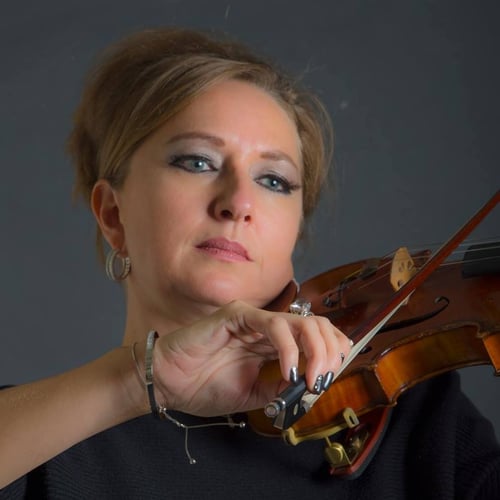
Heather Kaye Broadbent is an international violinist and pedagogue specializing in adult violin education. She is the founder of the Broadbent School of Violin Artistry, where her work centers on thoughtful technique, listening, and humane, lineage-informed pedagogy.
Her teaching is known for its clarity, calm structure, and respect for serious adult learners. She places strong emphasis on ergonomic setup, healthy mechanics, and listening as a primary musical skill.
Her mission is to offer violinists instruction in subjects they were expected to know — but never truly taught.
The Intonation Method is part of that mission.


