
An eight-workshop course in rhythmic understanding, violin coordination, and musical independence for adult violinists.
You know the notes. You understand the basic values. But when you begin playing, something happens.
The sixteenth notes rush. A dotted rhythm throws you off. A tie across the bar line makes you lose the beat. Or you can play a passage after listening to a recording, but struggle to figure out the rhythm independently.
Perhaps you count everything correctly in your head, yet your bow and left-hand fingers don't seem to cooperate.
Sound familiar?
Rhythmic difficulties are not always counting problems.
They can arise from an uncertain internal pulse, unfamiliar rhythmic groupings, physical coordination, or simply not knowing how to approach what you see on the page.
The Rhythmic Violinist helps you understand these challenges and develop the skills to work through them.
Through eight original, interactive violin workshops, I guide you from the foundations of pulse and subdivision to compound meters, syncopation, complex rhythmic groupings, and their practical application to violin playing.
The objective is not simply to play the correct rhythm once.
It is to understand rhythm so thoroughly that you can recognize it, feel it, and play it independently.
Rhythm Is More Than Counting
A quarter note is not simply a mathematical value. It exists within a pulse, a meter, and a musical phrase.
An eighth note can be part of a simple subdivision, a compound grouping, or an unexpected rhythmic accent.
And a rest does not mean the music has stopped.
When you understand these relationships, rhythm begins to make sense in a different way.
You start recognizing rhythmic groupings rather than calculating individual notes.
You anticipate the beat rather than waiting for the metronome to tell you where it is.
You learn to feel the pulse even when no note is played on it.
And you develop the physical coordination to translate that understanding into sound.
Rhythm becomes part of your musicianship rather than an obstacle to it.

A Violin-Specific Approach to Rhythmic Understanding
Rhythm cannot be separated entirely from the physical act of playing the violin.
Your bow arm must organize movement through time.
Your left-hand fingers must coordinate with that movement.
Your eyes must recognize the notation, and your musical understanding must anticipate what comes next.
If one of these elements becomes uncertain, the rhythm can fall apart.
Throughout this course, I show you how to identify which element is causing the difficulty.
We may begin by speaking or tapping a rhythm.
Then we might pluck the notes, play the rhythm on an open string, or isolate a particular bowing pattern.
Only when the underlying structure becomes clear do we bring the complete musical passage together.
This approach follows three essential stages:
Learning → Understanding → Internalizing
We first learn the rhythmic principles.
We then explore how those principles function within musical time.
Finally, we develop the physical coordination and musical awareness necessary to make rhythm an integrated part of violin playing.
What You'll Learn
Throughout the eight workshops, you will develop a deeper understanding of how to:
- Establish a reliable internal pulse and maintain it through changing rhythmic patterns.
- Understand subdivisions and recognize rhythmic groupings more naturally.
- Feel the difference between stronger and weaker beats in different meters.
- Play eighth notes, triplets, sixteenth notes, and sextuplets with greater precision.
- Understand dotted rhythms, ties, rests, syncopation, and offbeat entrances.
- Coordinate the bow arm and left hand without compromising rhythmic accuracy.
- Use the metronome effectively, including choosing between larger beats and smaller subdivisions.
- Understand simple meters such as 2/4, 3/4, and 4/4.
- Explore 5/4, 3/8, and compound meters including 6/8, 9/8, and 12/8.
- Approach unfamiliar time signatures such as 3/2 and introductory irregular meters.
- Read rhythms more independently without always needing to hear a recording first.
- Maintain rhythmic continuity when playing with an ensemble or accompaniment.
- Apply rhythmic understanding to scales, études, and musical repertoire.
- Identify the source of a rhythmic difficulty and develop an effective way to practice it.
Most importantly, you'll learn how to approach unfamiliar rhythms with greater understanding and confidence.
Inside The Rhythmic Violinist
Eight Original Workshops. A Progressive Journey Toward Rhythmic Independence.
Workshop 1 — Pulse & Rhythmic Foundations
Establish a reliable pulse and develop confidence with subdivision and rhythmic recognition.
Workshop 2 — Internal Pulse & Coordination
Strengthen rhythmic independence through metric stress, ties, rests, and bow coordination.
Workshop 3 — Rhythmic Precision & 3/4 Time
Refine rhythmic accuracy and develop fluency with changing subdivisions.
Workshop 4 — Expanding Your Rhythmic Vocabulary
Explore 5/4, introduce 3/8, and connect rhythmic understanding with musical phrasing.
Workshop 5 — Sixteenth Notes & Technical Coordination
Develop greater rhythmic fluency through efficient bow movement and left-hand coordination.
Workshop 6 — Compound Meters & Musical Independence
Understand 6/8, 9/8, and 12/8 while strengthening internal hearing and rhythmic confidence.
Workshop 7 — Dotted Rhythms & Musical Integration
Connect rhythmic reading with left-hand technique, bowing, and expressive playing.
Workshop 8 — Advanced Rhythms & Confident Application
Explore changing meters, 3/2, and the skills needed to approach unfamiliar rhythms independently.

Real Musical Challenges. Practical Solutions.
The Rhythmic Violinist is more than a collection of exercises.
Developed through eight live workshops with adult violinists, this course addresses the real rhythmic difficulties that arise in learning and performing music.
Drawing on years of teaching experience and the questions students encounter in their playing, I explore why rhythmic challenges occur and demonstrate practical ways to overcome them.
Sometimes the solution is to simplify a rhythmic grouping. Sometimes it's to change the metronome setting, isolate the bow arm, or approach a passage from a different perspective.
You'll learn not only how to play rhythms accurately, but how to recognize, understand, and solve rhythmic problems independently.

From Rhythmic Understanding to Musical Expression
Rhythm gives music direction, movement, character, and expression.
Throughout the course, we connect rhythmic principles with the physical demands of violin playing and their application to musical repertoire.
You'll discover how a reliable internal pulse supports technical coordination, how rhythmic groupings influence phrasing, and how a deeper understanding of musical time allows you to play with greater freedom.
As rhythm becomes more natural, your attention can move beyond counting and toward the music itself.

Who Is This Course For?
The Rhythmic Violinist is designed for adult violinists who want to develop greater rhythmic confidence and independence.
Adult violin students who struggle with counting, subdivisions, or maintaining a steady pulse.
Returning violinists who want to strengthen their foundations and rebuild confidence.
Self-taught violinists who want to become more independent in reading and understanding unfamiliar music.
Intermediate and advancing violinists who encounter challenges with syncopation, compound meters, faster subdivisions, or ensemble playing.
Violin and viola teachers looking for practical approaches to explaining rhythm and addressing common rhythmic difficulties.
A basic familiarity with reading musical notation and playing the violin is recommended.
What's Included
Eight Original Recorded Workshops
Eight comprehensive workshops featuring detailed instruction, musical demonstrations, and practical solutions to the rhythmic challenges violinists encounter in their playing.
Companion Lesson Guides
Written summaries and suggested practice activities to help you understand and apply the material presented in each workshop.
Supporting Rhythmic Exercises
Violin-specific exercises and study materials included with the course.
Musical Applications
Practical connections between rhythmic understanding, bow technique, scales, études, and repertoire.
Self-Paced Study
Progress through the workshops at your own pace and revisit individual lessons whenever you need reinforcement.
Choose Your Enrollment Option
Monthly Access — $55/month
Enjoy access to all eight original workshops, companion lessons, and included practice materials while your subscription remains active.
Study at your own pace and cancel whenever you choose.
Lifetime Access — $175 One-Time Payment
Receive lifetime access to the complete eight-workshop course and accompanying materials.
Return to the lessons whenever you encounter new rhythmic challenges in your violin repertoire.
The lifetime option offers the best value for students who want an enduring resource for their musical development.
Understand the Rhythm. Feel the Pulse. Express the Music.
Choose the enrollment option that works best for you and begin developing greater rhythmic confidence and independence on the violin.
Meet Your Instructor
Professional Violinist | Violin Educator | Founder of the Broadbent School of Violin Artistry
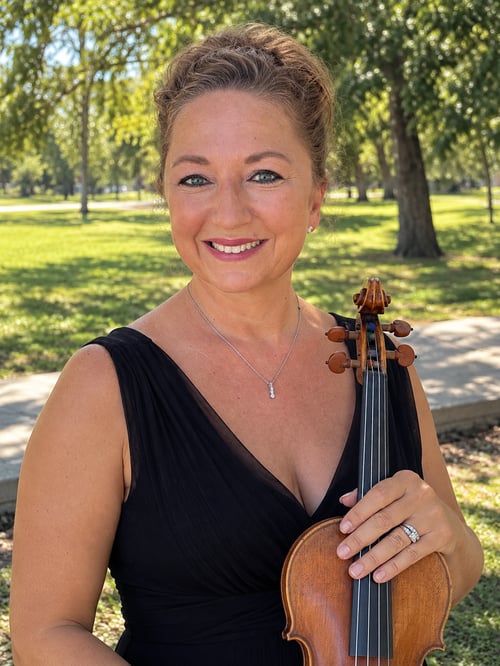
Heather Kaye Broadbent is a professional violinist and international violin educator whose teaching emphasizes musical understanding, technical coordination, and the development of independent artistry.
Through the Broadbent School of Violin Artistry, Heather helps adult violinists move beyond mechanical repetition toward more intelligent, effective, and expressive playing.
Her approach focuses on understanding why difficulties occur and developing practical strategies to overcome them.