The Art of Learning Violin
The Complete Adult Beginner Course
A structured introduction to violin playing, grounded in the great European teaching traditions and designed especially for adult learners.

A structured introduction to violin playing, grounded in the great European teaching traditions and designed especially for adult learners.
Perhaps you've dreamed of playing the violin for years.
Perhaps you've already begun, but find yourself moving between YouTube tutorials, exercises, and beginner pieces without knowing whether you're building the right skills.
You want to make beautiful music. You want to understand what you're doing. And you want to know that the time you devote to practicing is taking you somewhere.
The Art of Learning Violin offers something different: a complete, carefully sequenced course of study created by a professional violinist who specializes in teaching adults.
You'll learn to develop your sound, coordinate your hands, read music, understand rhythm, and bring these skills together through carefully selected repertoire.
No previous musical experience is required.
Begin for $29/month or choose lifetime access for $149.
The internet is full of violin lessons.
You can find a video explaining how to hold the bow, another demonstrating a scale, and another teaching a familiar melody.
But who explains how those skills belong together?
On the violin, everything is connected.
Your left-hand organization influences your intonation. Your bowing influences the quality of your sound. Your understanding of rhythm shapes the coordination of both hands.
Without a thoughtful sequence, it's possible to spend months practicing individual exercises without understanding how they contribute to your development.
The Art of Learning Violin brings those elements together in a progressive curriculum.
Instead of guessing what to practice next, you'll have a clear path from your first notes to increasingly confident, musical playing.
And you'll understand why you're learning each skill.
Adult beginners deserve serious instruction.
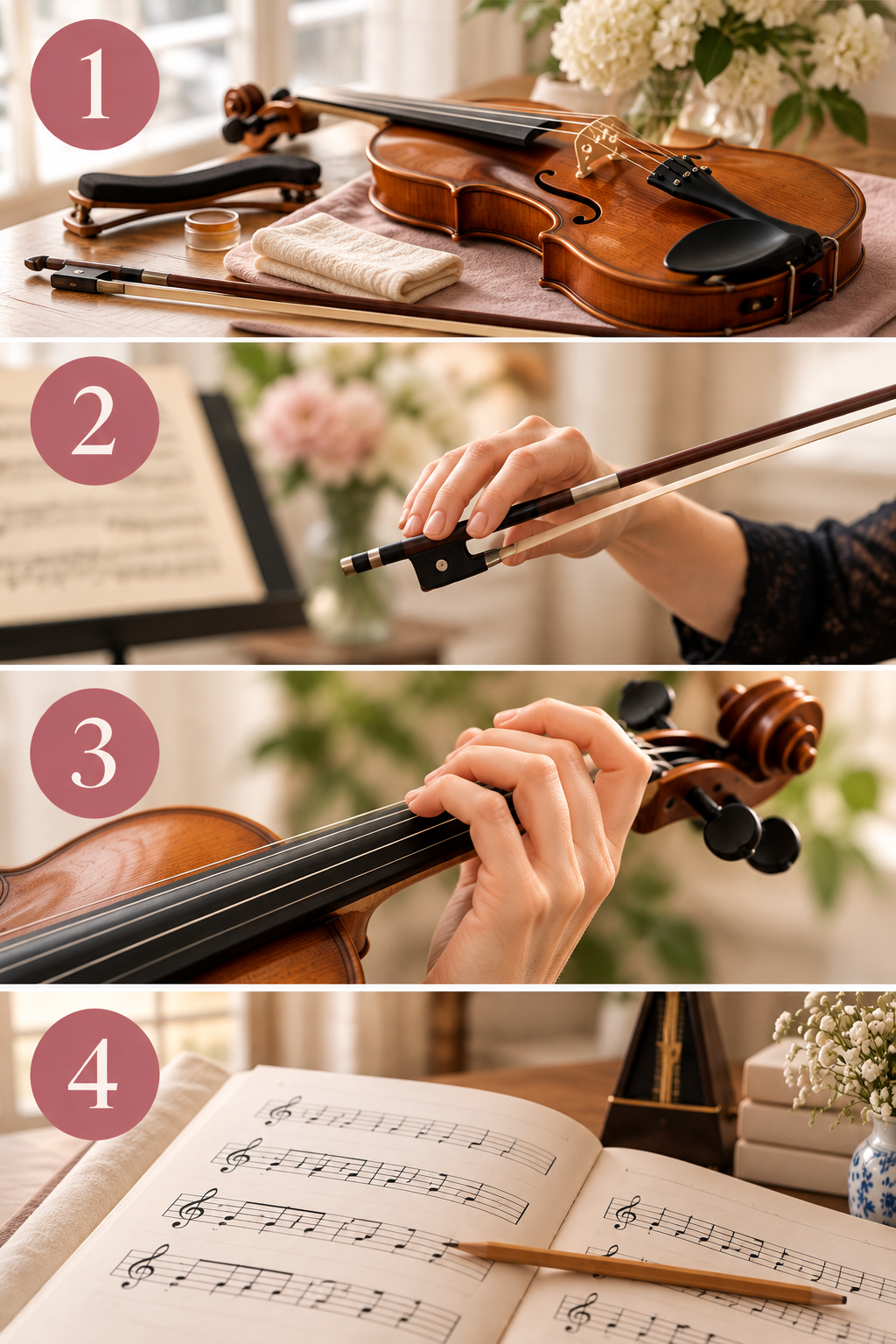
Learn how to hold and organize the violin and bow, establish comfortable playing habits, and develop the coordination needed for reliable technique.
You'll explore the relationship between the body, the instrument, and the movements that produce sound.
The bow is the voice of the violin.
Through guided instruction and practical exercises, you'll begin developing bow control, coordination, and the ability to produce a clear, balanced sound.
Learn how finger patterns work, how to organize the hand, and how to develop accurate intonation through attentive listening and carefully sequenced practice.
Develop the music-reading and rhythmic skills that allow you to become an increasingly independent musician.
You don't need to arrive knowing how to read notation. You'll learn as you progress.
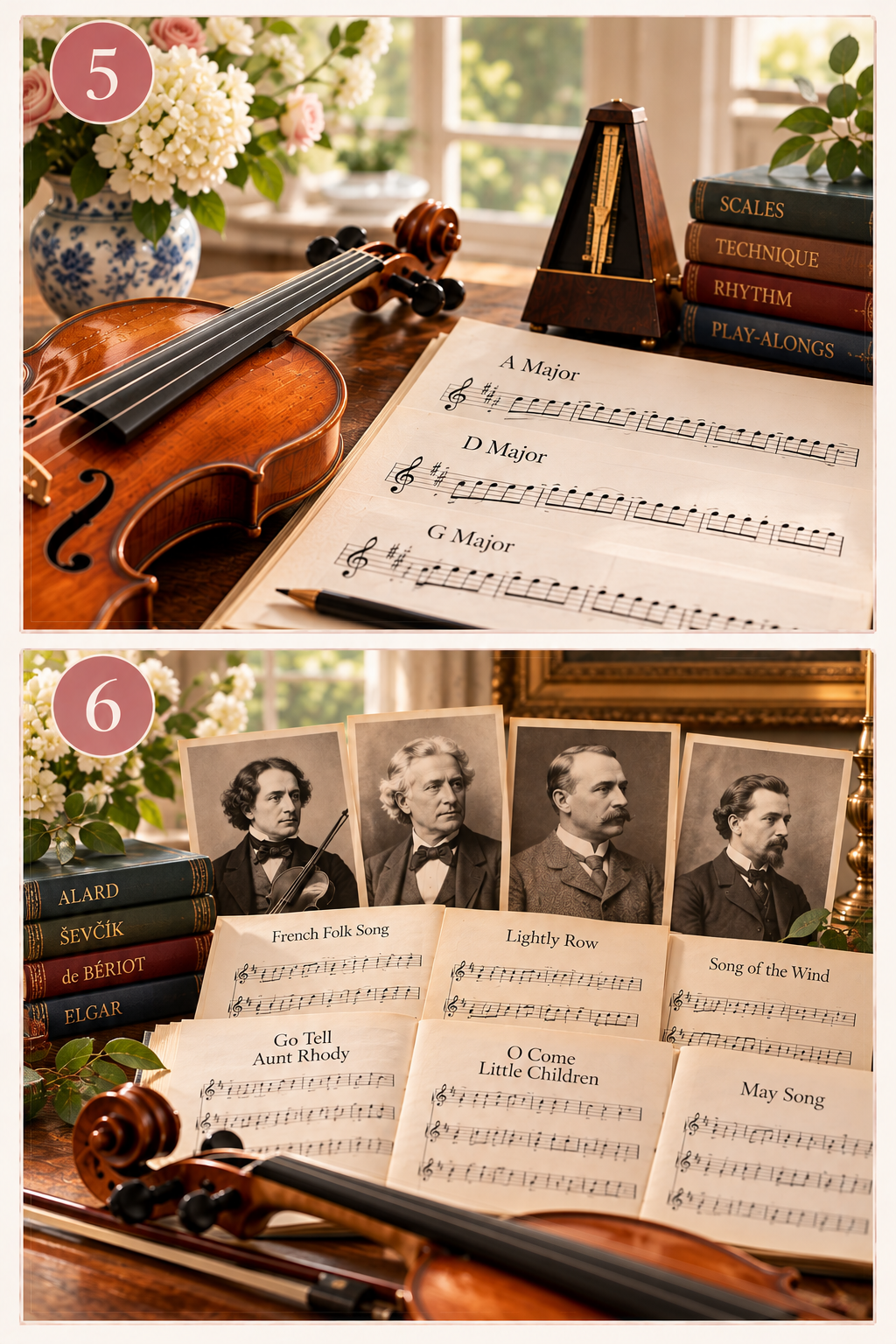
Study A major, D major, and G major through video demonstrations, technical exercises, rhythmic variations, and guided play-alongs.
You'll discover how these essential patterns prepare you for the music you're learning.
Progress through familiar early violin repertoire, including French Folk Song, Lightly Row, Song of the Wind, Go Tell Aunt Rhody, O Come Little Children, and May Song.
Each piece is supported by technical preparation, practice assignments, and opportunities to play along.
Rather than simply learning one piece after another, you'll understand the skills each piece is designed to develop.
Knowing what to practice is only part of learning an instrument.
Knowing how to practice is equally important.
Throughout The Art of Learning Violin, you'll find video instruction, technical preparation, guided exercises, practice assignments, and play-alongs that help you put each new skill into action.
For example, your scale studies don't exist in isolation.
You'll learn the finger patterns, work through rhythmic variations, apply those patterns to repertoire, and reinforce your coordination through guided practice.
You aren't left alone with a piece of sheet music and a vague instruction to practice.
You're given the tools to understand the work and make meaningful progress.
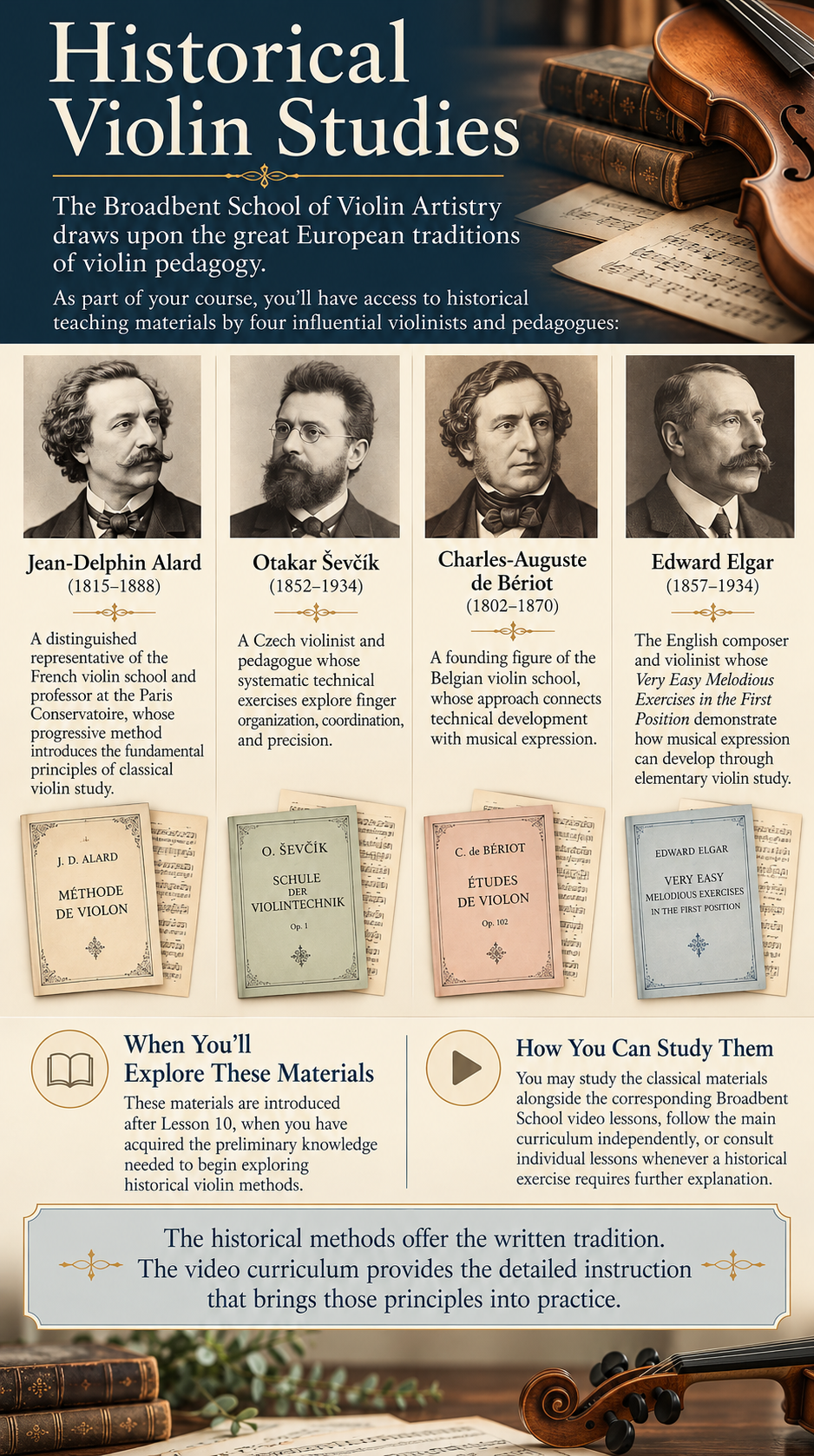
The Broadbent School of Violin Artistry draws upon the great European traditions of violin pedagogy.
As part of your course, you'll have access to historical teaching materials by four influential violinists and pedagogues:
Jean-Delphin Alard (1815–1888) — A distinguished representative of the French violin school and professor at the Paris Conservatoire, whose progressive method introduces the fundamental principles of classical violin study.
Otakar Ševčík (1852–1934) — A Czech violinist and pedagogue whose systematic technical exercises explore finger organization, coordination, and precision.
Charles-Auguste de Bériot (1802–1870) — A founding figure of the Belgian violin school, whose approach connects technical development with musical expression.
Edward Elgar (1857–1934) — The English composer and violinist whose Very Easy Melodious Exercises in the First Position demonstrate how musical expression can develop through elementary violin study.
These materials are introduced after Lesson 10, when you have acquired the preliminary knowledge needed to begin exploring historical violin methods.
You may study the classical materials alongside the corresponding Broadbent School video lessons, follow the main curriculum independently, or consult individual lessons whenever a historical exercise requires further explanation.
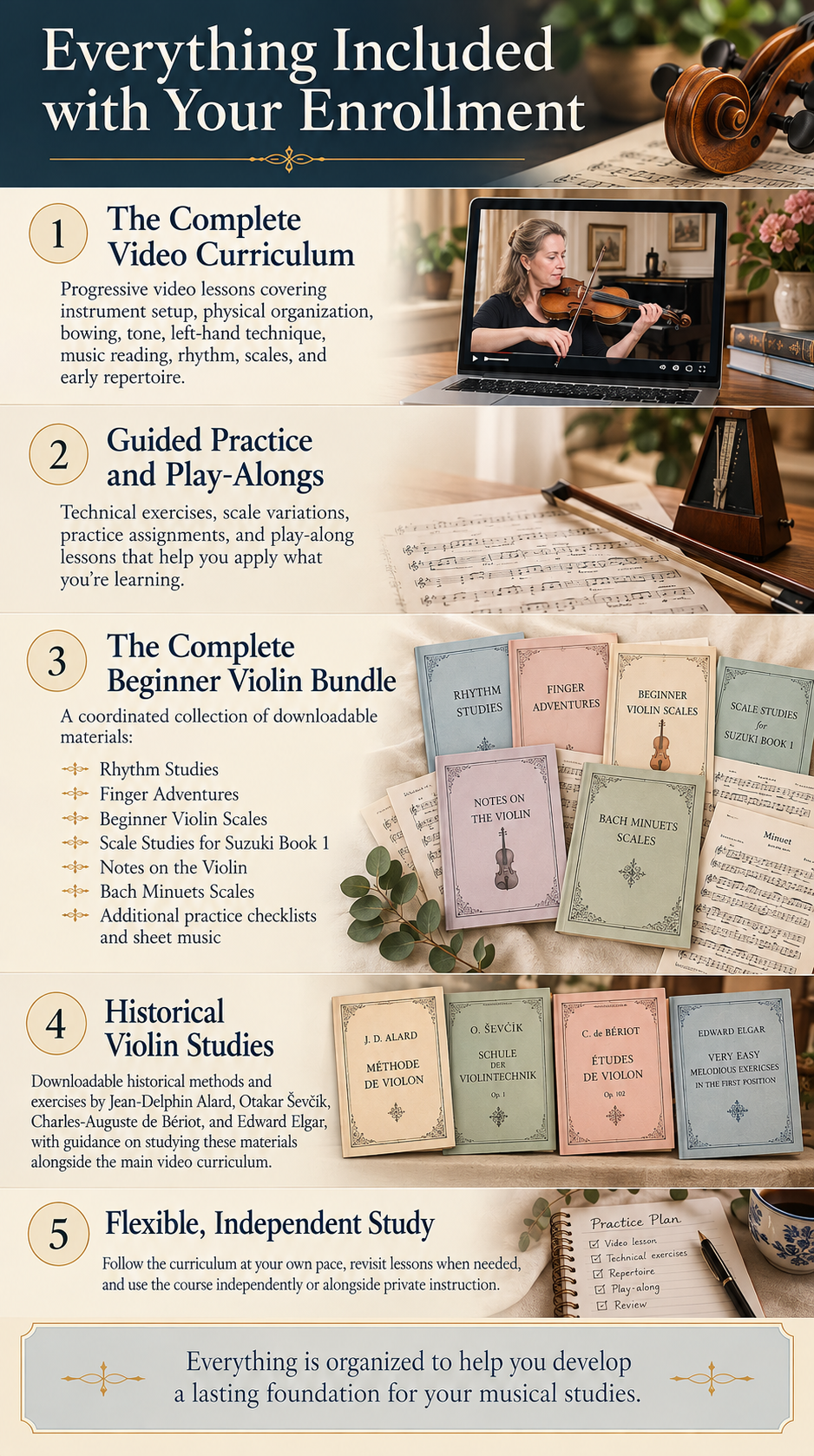
Progressive video lessons covering instrument setup, physical organization, bowing, tone, left-hand technique, music reading, rhythm, scales, and early repertoire.
Technical exercises, scale variations, practice assignments, and play-along lessons that help you apply what you're learning.
A coordinated collection of downloadable materials:
Downloadable historical methods and exercises by Jean-Delphin Alard, Otakar Ševčík, Charles-Auguste de Bériot, and Edward Elgar, with guidance on studying these materials alongside the main video curriculum.
Follow the curriculum at your own pace, revisit lessons when needed, and use the course independently or alongside private instruction.
There is no deadline for learning the violin.
Some skills develop quickly. Others benefit from weeks of attentive practice and repeated exploration.
The Art of Learning Violin is designed to accommodate that natural process.
You can spend additional time on a scale, revisit a bowing exercise, or return to an earlier piece with greater understanding.
Your progress is measured not by how quickly you finish a curriculum, but by the quality and confidence of your playing.
The course provides the structure. You determine the pace.
This course is designed for adults who:
You don't need previous experience, musical knowledge, or a particular level of natural ability.
You need curiosity, a willingness to practice, and a clear place to begin.
Whether you prefer a smaller monthly commitment or permanent access to your course materials, the quality of instruction is the same.
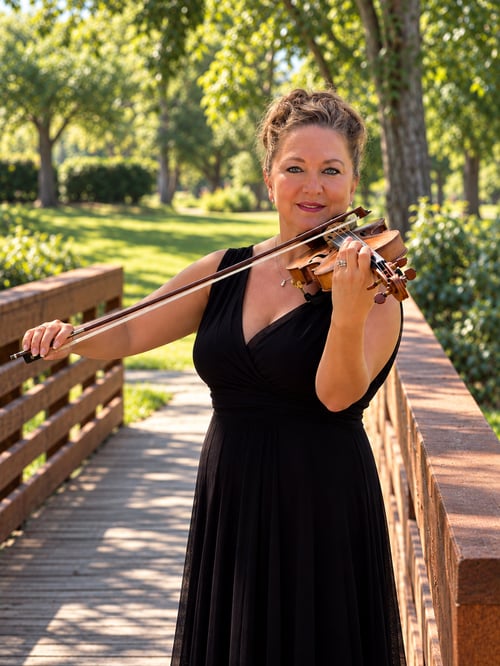
Professional Violinist · Educator · Founder of the Broadbent School of Violin Artistry
I believe adult violinists deserve an education that respects both their intelligence and their musical ambitions.
My teaching is grounded in the European violin traditions, particularly the French and Russian schools, and informed by a lifelong commitment to the study and performance of the violin.
I specialize in working with adult learners, from those beginning their first lessons to experienced musicians seeking greater technical clarity and artistic freedom.
Over the years, I've seen how much can change when a student finally understands the principles behind a movement, a sound, or a technical difficulty.
That understanding is what I want to give you.
I created The Art of Learning Violin to offer adults a carefully organized beginning: one that explains the instrument clearly, develops technique intelligently, and introduces musical expression from the start.
My goal isn't simply to teach you your first pieces. It's to help you become a thoughtful, independent violinist.
Learning the violin as an adult is a remarkable undertaking.
It asks for patience, curiosity, careful listening, and a willingness to discover new ways of moving and thinking.
It also offers something extraordinary: the ability to make music with your own hands.
You deserve a beginning that honors that ambition.
The Art of Learning Violin brings together professional instruction, classical pedagogical principles, guided practice, and a carefully sequenced curriculum designed for adults.
Not simply to help you play your first notes.
To help you begin the lifelong art of playing the violin.
The Complete Adult Beginner Course
$29/month or $149 for lifetime access
Immediate access to digital course materials. All sales are final and non-refundable.
As a beginner violinist, I had only sporadically used my fourth finger. But with the help of your book, I could for the first time focus completely on using the fourth finger. My tone and intonation improved enormously from your exercises alone in only 6 weeks!
I have learned so much.
After 26 years of not playing, I decided to purchase my own violin and take this beautiful instrument up again. I have learned so much through Heather's videos and exercise books which are very easy to follow. Can't recommend Heather's materials enough!
I very much enjoyed the play-along videos. Thank you so much for all your help. I love this programme.
No. Adults can develop meaningful musical and technical skills at many stages of life. This course is designed specifically for adult learners.
No. Music reading and rhythm are introduced within the curriculum.
The course is designed to provide a structured foundation for independent study. It can also complement private lessons.
Monthly subscribers have access while their subscription is active. Lifetime purchasers pay once for ongoing access to the course.
Yes. You can cancel your subscription without committing to a fixed number of months.
Downloadable books and exercises are included with both enrollment options for individual study.
Monthly subscribers retain access to the online course while their subscription is active; downloaded materials remain subject to the Broadbent School's personal-use license.